

Starting a Business at Home: The Complete Roadmap to Building Your Remote Empire
- Sophie Ricci
- Views : 28,543
Table of Contents
The 9-to-5 grind is dead.
You know it. Your neighbor who just bought a Tesla working from his living room knows it. Even your mom knows it.
Here’s the truth that nobody tells you: Starting a business at home isn’t just possible anymore—it’s actually easier than commuting to an office job. The overhead is lower. The barriers are gone. And the potential? Unlimited.
As of 2025, over 36 million small businesses operate in the United States, with a massive portion running entirely from home. These aren’t hobbyists selling crafts on Etsy (though respect to them). These are serious business owners generating serious revenue—many hitting 6-figures without ever renting an office.
But here’s where most people mess up: they dive in without a plan, burn out in 3 months, and go back to complaining about their boss. This guide is your insurance policy against that fate. We’re covering the boring-but-critical stuff (legal structure, insurance, banking) and the exciting stuff (tech stack, automation, revenue models) so you can launch smart and scale fast.
Let’s get into it.
Why Starting a Business at Home Works in 2025
The economics have flipped. Twenty years ago, you needed a physical location to be taken seriously. Today? Your clients expect you to be remote.
The data backs this up:
- Small businesses account for 46% of private sector employment in the US
- They created 90% of net new jobs between March 2023 and March 2024
- The average home-based business has 70% lower overhead than traditional brick-and-mortar operations
What changed? Three things:
Cloud infrastructure got insanely good. You don’t need servers, expensive software licenses, or IT teams. Everything runs on subscription tools that cost less than your coffee habit.
Remote work became normalized. Pre-2020, “home-based business” had a garage-sale vibe. Now? It signals efficiency and flexibility. Your clients don’t care where you work—they care that you deliver.
The fractional economy exploded. Companies realized they don’t need full-time employees for everything. They need specialists who can parachute in, solve problems, and disappear. That’s where you come in.

Three Low-Overhead Business Ideas You Can Start Tomorrow
Let’s get specific. You don’t need a revolutionary idea. You need a model that prints money while you sleep (or at least while you’re making lunch).
The Lead Generation Machine
This is the bread and butter for anyone who understands outbound. You’re not selling products. You’re selling opportunities—qualified meetings on your client’s calendar.
How it works: You scrape data, verify emails, write killer copy, and automate sequences that book meetings. Your clients pay you $2,000-$5,000 monthly because you’re solving their biggest pain: an empty pipeline.
The beauty? Once you build the infrastructure, one person can manage campaigns for 5-10 clients simultaneously using tools like cold email software and LinkedIn automation.
Reality check: This isn’t passive income on day one. You’ll spend weeks building lists, testing copy, and optimizing deliverability. But once it’s humming? It’s a cash machine.
🚀 Struggling with Empty Pipelines?
Let SalesSo build your complete outbound engine—targeting, campaigns, and scaling included.
he Fractional Expert Model
Instead of automation, this is high-touch. You embed yourself into 2-3 companies part-time, bringing senior-level expertise at a junior-level price point.
Example: A startup needs outbound calling but can’t afford a $100K full-time hire. You offer 10 hours weekly for $4,000/month. They get a pro. You stack 3 clients and make $12K/month.
Who this works for: People who thrive on variety and have deep expertise in a specific area (sales, operations, strategy). If you’ve closed $1M+ deals, you can charge a premium here.
The Operations Fixer
Many companies buy expensive CRM systems (Salesforce, HubSpot) and then use 10% of the features. Their data is a mess. Their forecasts are wrong. Their team hates logging activities.
Your move: Audit their stack, build custom workflows, train their team, and charge $5,000-$15,000 per project. As you scale, add a monthly retainer for ongoing “RevOps” support.
Key advantage: This is purely intellectual work. No inventory. No physical products. Just your brain and a Zoom link.
Tools like workflow automation software make this even more powerful by connecting systems that should already be talking to each other.
The Boring Stuff That Protects Your Future (Legal & Financial Setup)
Skip this section and you’re gambling with your house, car, and savings. Not kidding.
Why You Need an LLC (and How to Get One)
A Limited Liability Company creates a legal wall between your personal assets and your business. If a client sues you for “breach of contract,” they can only go after the business—not your personal bank account.
The alternative? Operating as a sole proprietorship, where you and the business are legally the same entity. One lawsuit and your personal assets are fair game.
Cost: $50-$800 depending on your state (usually closer to $200). Do it online through your state’s Secretary of State website or use services like ZenBusiness or LegalZoom if you want hand-holding.
Pro tip for UK readers: The equivalent is a Private Limited Company (Ltd), which offers similar liability protection and potential tax efficiency.
The Business Checking Account You Actually Need
Here’s a rookie mistake: mixing personal and business finances in one account. Buy a coffee for yourself, charge a client subscription—all in the same transaction history.
This is called “commingling,” and it can destroy your LLC’s legal protection. Courts can “pierce the corporate veil” and come after your personal assets anyway.
Solution: Open a dedicated business checking account the day you get your EIN (Employer Identification Number).
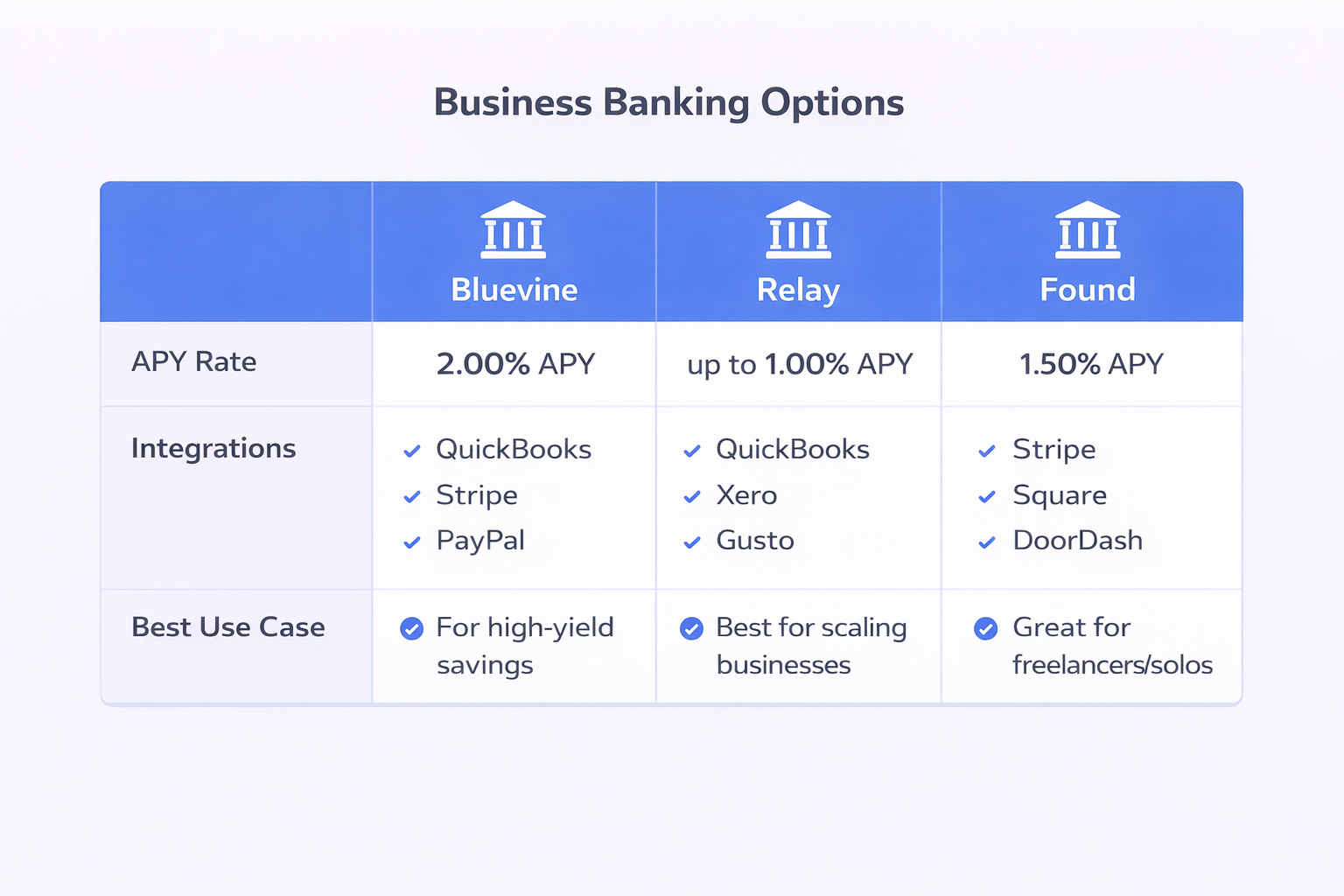
Top picks for 2025:
- Bluevine: Offers up to 2.0% APY on operating balances (that’s free money while you hold cash for taxes). Integrates with QuickBooks and Xero.
- Relay: Perfect if you follow the “Profit First” methodology. Create multiple sub-accounts (Income, Tax, Owner Pay, OpEx) and automate fund allocation.
- Found: Built for solopreneurs with built-in tax tracking and invoicing, reducing your need for separate accounting software.
💰 Need Qualified Leads Fast?
SalesSo generates meetings with decision-makers through proven LinkedIn and email outreach systems.

Business Insurance: Don’t Skip This
“I work from my laptop. What could go wrong?”
Famous last words. Here’s what can go wrong: A client claims your advice cost them $50K in lost revenue. They sue. Without insurance, you’re paying the legal bills out of pocket.
Essential coverage:
Professional Liability (E&O Insurance): Covers you if your advice or service causes financial harm to a client. Cost: $22-$60/month. Non-negotiable if you’re consulting.
General Liability: Covers physical accidents and “advertising injury” (like accidentally using copyrighted images in your marketing). Cost: ~$42-$50/month bundled with property coverage.
Cyber Liability: If you handle customer data (emails, contact lists, CRM info) and get hacked, this covers notification costs, legal fees, and forensic audits. Cost: $70-$90/month.
Reality: Most home-based consultants can get a Business Owner’s Policy (BOP) that bundles General Liability and Property insurance for around $50/month. Stop gambling with your financial future.
Your Cold Outreach Tech Stack (The Growth Engine)
Let’s talk about the system that actually generates revenue. If you’re doing any type of B2B lead generation—whether for yourself or clients—you need bulletproof cold outreach infrastructure.
The Problem: Domain Reputation
When you buy a new domain (youragency.com), it’s a stranger to email providers like Gmail and Outlook. If you immediately blast 200 cold emails, you’ll get flagged as spam before lunch.
Worse? If you burn your main domain, you lose the ability to email clients, send invoices, or conduct normal business. That’s a death sentence.
The Solution: Strategic Infrastructure
Professional outbound never sends cold emails from the main domain. Instead, you use “satellite domains” for outreach.
Example:
- Main domain: youragency.com (website, inbound leads, client communication) — NEVER used for cold outreach
- Sending domains: youragency-outreach.com, get-youragency.com, try-youragency.net
If a sending domain gets burned? You discard it ($10 loss) and spin up a new one. Your main brand stays pristine.
📧 Cold Email Not Working?
We handle targeting, copywriting, and technical setup so you only focus on closing deals.
The Technical Trinity: SPF, DKIM, DMARC
To land in the Primary Inbox (not spam), you need three cryptographic protocols configured:
SPF (Sender Policy Framework): A DNS record that says “IP Address X is authorized to send email for this domain.”
DKIM (DomainKeys Identified Mail): A digital signature proving your email wasn’t tampered with in transit.
DMARC (Domain-based Message Authentication): A policy telling receiving servers what to do with emails that fail SPF or DKIM checks.
Critical: As of 2025, Google and Yahoo enforce strict DMARC policies. Without it, your emails bounce automatically or land in spam.
Inbox Rotation & Warm-Up
Instead of sending 500 emails from one inbox, professional tools rotate through 10+ accounts, sending only 50 emails each. This mimics human behavior and flies under spam radar.
Warm-up pools: Networks of thousands of real inboxes that automatically trade emails with your new accounts, opening them, marking them important, and removing them from spam. This builds reputation before your first sales email ever sends.
Tools like LinkedIn prospecting combined with email outreach create a multi-channel approach that multiplies results.

Building Your Home Office Command Center
Your home office isn’t just a desk—it’s your broadcast studio, your war room, your revenue generator.
Audio Quality = Authority
Tinny, echoing audio kills trust instantly. Rich, clear voice builds authority.
Quick wins:
- Krisp.ai: AI-powered noise cancellation that removes background noise on both ends of the call
- Passive soundproofing: Hang heavy curtains, add rugs, or install acoustic foam panels to kill echo
- Mass Loaded Vinyl: The nuclear option for blocking sound transmission through walls/doors
Lighting: The Trust Multiplier
Ever see someone on a call who looks like they’re being interrogated? That’s overhead lighting creating the “ghoul effect.”
Three-point lighting setup:
- Key Light: Brightest, positioned 45 degrees to your side
- Fill Light: Softer, opposite side to eliminate harsh shadows
- Back Light: Behind you, separating you from the wall
Golden rule: Never sit with a window behind you (you’ll be a dark silhouette). Face the window or black it out and use controlled LED lighting.
Background: Real > Virtual
Virtual backgrounds look glitchy and amateurish unless you have a proper green screen. A real, curated background (bookshelf, clean wall, plant) signals stability and professionalism.

🎯 Generate 20+ Meetings Monthly
Our complete LinkedIn outbound system delivers qualified conversations with your ideal customers.
7-day Free Trial |No Credit Card Needed.
Balancing Work & Home Life Without Losing Your Mind
The biggest threat isn’t failure—it’s burnout. When your office is 10 feet from your bedroom, boundaries dissolve fast.
Create Physical Boundaries
Dedicated workspace: Ideally a separate room with a door. Crossing that threshold signals a psychological shift between “work mode” and “life mode.”
No separate room? Use a folding screen, a specific “work rug,” or even just a different chair to create mental separation.
The clock-out ritual: End of day, shut down the computer, physically leave the workspace. Train your brain that work has ended.
The “Zero-Dollar Day” Rule (With Limits)
Productivity tip from top performers: never have a day that generates zero value. Make one sales call. Send one proposal. Write one piece of content.
But: Balance this with hard boundaries. Time-block your work hours. Use “Do Not Disturb” modes aggressively. Your business is a marathon, not a sprint.
Managing the Side Hustle Conflict
Starting while still employed? Tread carefully.
Review your employment contract for conflict of interest and non-compete clauses. Some companies prohibit side businesses in the same industry.
Never use company resources (laptop, CRM, proprietary data) for your side business. This is theft and grounds for termination.
Time management: Use early mornings or late evenings for your business, ensuring zero overlap with your employer’s time.
Using tools like LinkedIn message automation can help you maximize limited hours by automating repetitive tasks.
Your One-Page Business Plan
Forget 50-page documents that nobody reads. You need a one-page business plan that sits on your desk and guides daily decisions.
Core Components:
Problem: What specific pain point are you solving?
Example: “B2B SaaS companies struggle to build consistent outbound pipeline.”
Example: “Done-for-you lead generation delivering 20+ qualified meetings monthly.”
Target Market: Who is your ideal customer? Be specific.
Example: “US-based B2B SaaS founders with $1M-$10M ARR.”
Revenue Model: How do you get paid?
Example: “Monthly retainer of $4,000 + $200 per qualified meeting booked.”
Marketing Strategy: How will you get clients?
Example: “Cold outreach campaigns and LinkedIn content demonstrating expertise.”
Milestones: 30/60/90 day goals.
Example: “First client by Day 30, $10K MRR by Day 90, $25K MRR by Day 180.”
Key insight: This document is living. It evolves as you learn. If an activity doesn’t serve your milestones, eliminate it ruthlessly.
According to recent LinkedIn marketing statistics, 80% of B2B leads come from LinkedIn, making it a critical channel for your early client acquisition.
Conclusion: The Best Time to Start Was Yesterday. The Second Best Time Is Now.
You have the skills. The market is massive (36 million small businesses and growing). The tools are accessible. The only variable left is execution.
Starting a business at home in 2025 isn’t a pipe dream—it’s a proven playbook. Get your legal structure right (LLC). Protect yourself with business insurance. Open that business checking account and segregate your finances. Build your outreach infrastructure properly so you don’t burn your domain on day three.
The fractional economy is exploding. Companies want specialists who can solve specific problems without the overhead of full-time employees. That’s your opening.
The lowest barrier to entry is today. Every day you wait is revenue you’re leaving on the table.
Tools like generating sales leads on LinkedIn have made it easier than ever to build a predictable pipeline without massive ad spend or expensive agencies.
Stop overthinking. Start building.
FAQs
What's the best home-based business to start with low investment?
Do I need an LLC to start a home-based business?Do I need an LLC to start a home-based business?
How much does business insurance cost for home-based consultants?
What's the best business checking account for solopreneurs?
Can I run a successful business from home in 2025?
We deliver 100–400+ qualified appointments in a year through tailored omnichannel strategies
- blog
- Sales Development
- Start a Business at Home: Your Complete 2026 Guide