
Pricing Architecture: Stop Trading Hours for Dollars
Billing hourly is the fastest way to cap your income and commoditize your expertise.
The math is broken: The slower you work, the more you earn. Strategic thinking that saves a client $100,000 in cloud costs gets billed the same as debugging CSS.
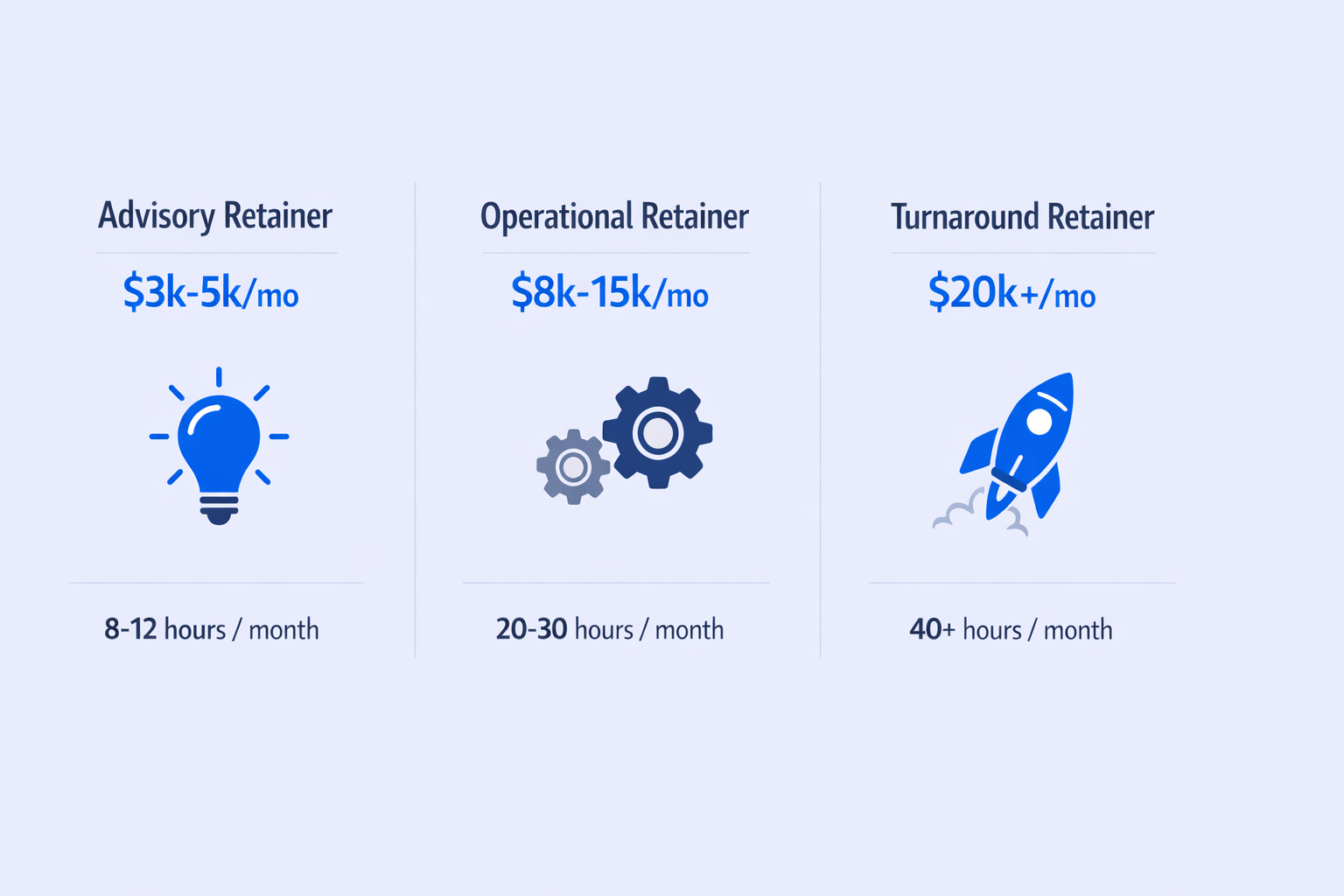
Successful fractional CTOs use value-based retainers.
Advisory Retainer ($3,000-$5,000/month): Weekly strategic syncs, code review oversight, emergency availability. Time commitment: 2-4 hours/week. According to Clutch’s 2024 Consulting Report, 73% of high-performing consultants use retainer models versus hourly billing.
Operational Retainer ($8,000-$15,000/month): Full “Head of Engineering” function. Managing sprints, hiring, vendor negotiation, architecture design. Time commitment: 1-2 days/week.
Turnaround Retainer ($20,000+/month): High-intensity crisis engagement for security breaches or failed product launches. Time commitment: 3 days/week.
Client Acquisition: The System That Actually Works
Here’s what doesn’t work: posting on LinkedIn hoping someone sees you.
Referrals are great but unpredictable. You need an outbound engine that generates predictable pipeline.
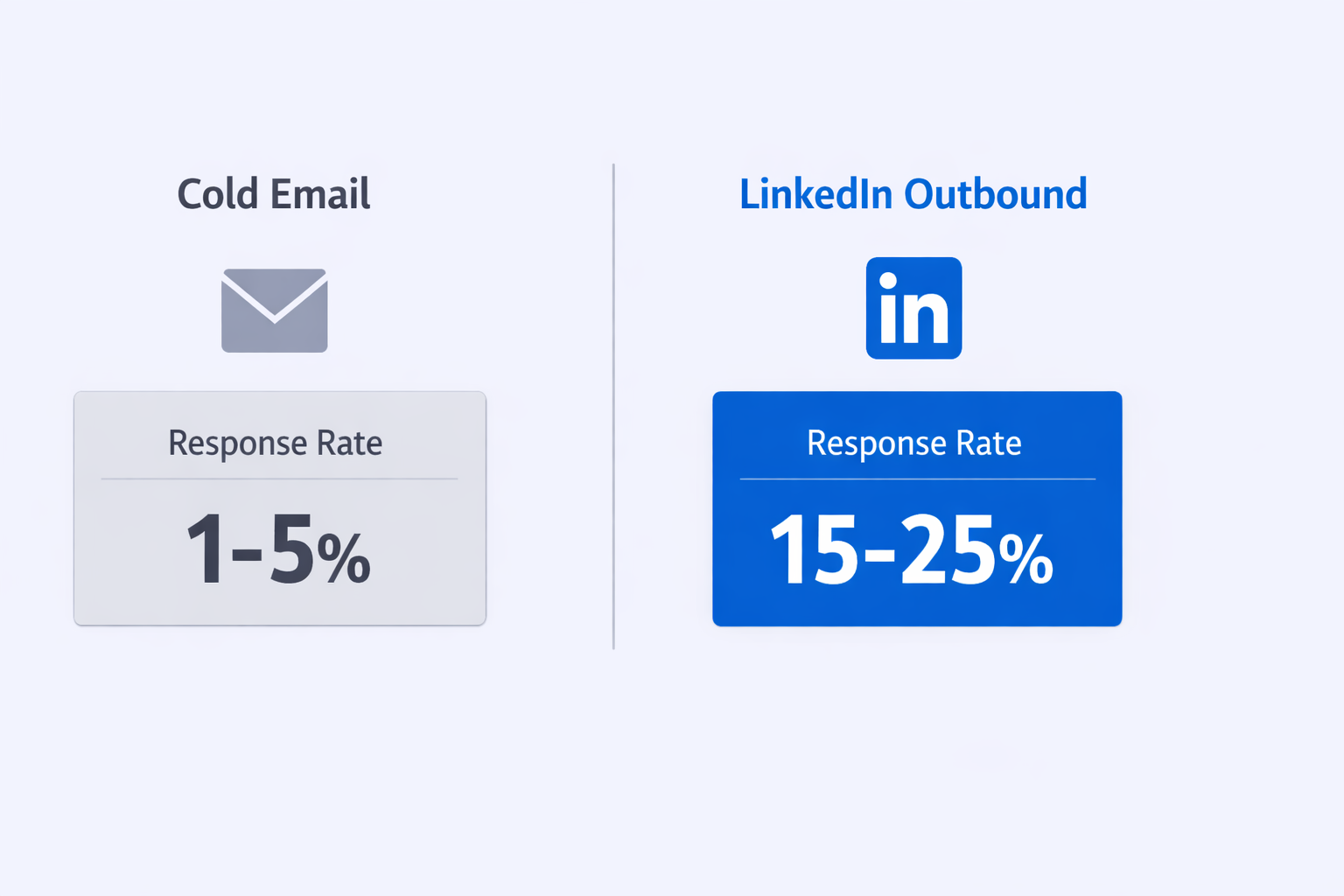
The traditional approach for most fractional CTOs is cold email. But here’s the problem: 1-5% response rates, spam filter battles, and deliverability nightmares.
According to Saleshandy’s 2024 Cold Email Benchmarks, the average cold email open rate is 44%, but response rates hover around just 1-5%.
There’s a better way: LinkedIn outbound.
Why LinkedIn Outbound Crushes Cold Email for CTO Services
Direct access to 65+ million decision-makers without bypassing spam filters or worrying about domain reputation.
15-25% response rates versus email’s 1-5%. According to LinkedIn’s own data, messages from profiles with complete information get 40% higher response rates than incomplete profiles.
No technical setup complexity. No SMTP configuration, no domain warm-up, no deliverability monitoring. Just direct professional conversations.
For fractional CTOs specifically, your ideal clients are already on LinkedIn. Founders, CEOs, and VPs of Engineering actively use the platform for hiring, networking, and learning.
Intent Data: Target Companies Before They Post Job Listings
Traditional outreach fails because it’s untargeted. Intent data changes the game by identifying companies signaling need before they know they need you.
Key intent signals for <a href=”https://salesso.com/blog/linkedin-automation-tool/”>fractional CTO</a> services:
Funding announcements: Companies raising Series A (visible on Crunchbase) have cash and immediate scaling pressure. According to Carta’s 2024 data, 87% of Series A companies hire senior technical leadership within 6 months of funding.
Key hires/departures: VP of Engineering leaving creates immediate vacuum. Perfect interim pitch opportunity.
Technology installations: Company installing enterprise tools (Salesforce, Kubernetes) indicates increasing technical complexity requiring leadership oversight.
Hiring velocity: Startup posting 10+ engineering roles simultaneously needs leadership to build the hiring machine. According to Lever’s recruiting data, companies with hiring surges above 15 roles face 3.7x higher management overhead.
The LinkedIn Outbound Message Framework
Your goal isn’t selling a $10k/month retainer in the first message. It’s selling a conversation.
The “Gap” Message (Trigger: CTO Job Posting)
Why it works: Hiring C-level executives takes 4-6 months. Founders are overwhelmed managing engineers during the search.
Message template:
“Hi [Founder Name],
Saw you’re searching for a permanent Chief Technology Officer. Finding the right fit typically takes 4-6 months—a lifetime in product development.
I help startups maintain engineering velocity during leadership transitions. Can step in to manage backlog and team, ensuring your new hire walks into a well-oiled machine instead of a fire drill.
Open to a brief chat about keeping your roadmap on track while you search?”
The “Scaling Pain” Message (Trigger: Series A Funding)
Why it works: Validates their success but highlights hidden risk (technical debt).
Message template:
“Hi [Name],
Congrats on the Series A raise.
In my experience with growth-stage startups, this is usually when ‘MVP code’ starts breaking under ‘scale-up traffic.’
I specialize in helping founders audit architecture to handle 10x growth without complete rewrites. Recently helped [similar company] reduce AWS costs 30% while doubling traffic.
I have a ‘Series A Tech Checklist’ I use for audits. Interested in seeing it?”
The Multi-Touch Cadence
One message isn’t enough. You need a sequence to cut through noise.
Day 1: Initial LinkedIn message (template above) Day 3: LinkedIn connection request (no pitch, just “Saw your news about X”) Day 5: Follow-up message with value (“Here’s that checklist…”) Day 8: “Break-up” message (“Assume this isn’t priority now…”)
According to SalesLoft’s 2024 Cadence Research, multi-touch sequences generate 3.4x more responses than single-touch outreach.
Your <a href=”https://salesso.com/blog/linkedin-profile-statistics/”>LinkedIn profile</a> must convert when they click. Headline formula: “Fractional CTO for [Industry] | Ex-[Credible Company] | Helping Startups Scale from Seed to Series B”
Post case studies regularly: “How we fixed a 3-day outage in 4 hours.” This builds passive trust so when your message arrives, they already know your expertise.
Execution and Delivery: The First 90 Days
Winning the client is 20% of the battle. Retention is 80%.
Onboarding: The “Listen First” Phase
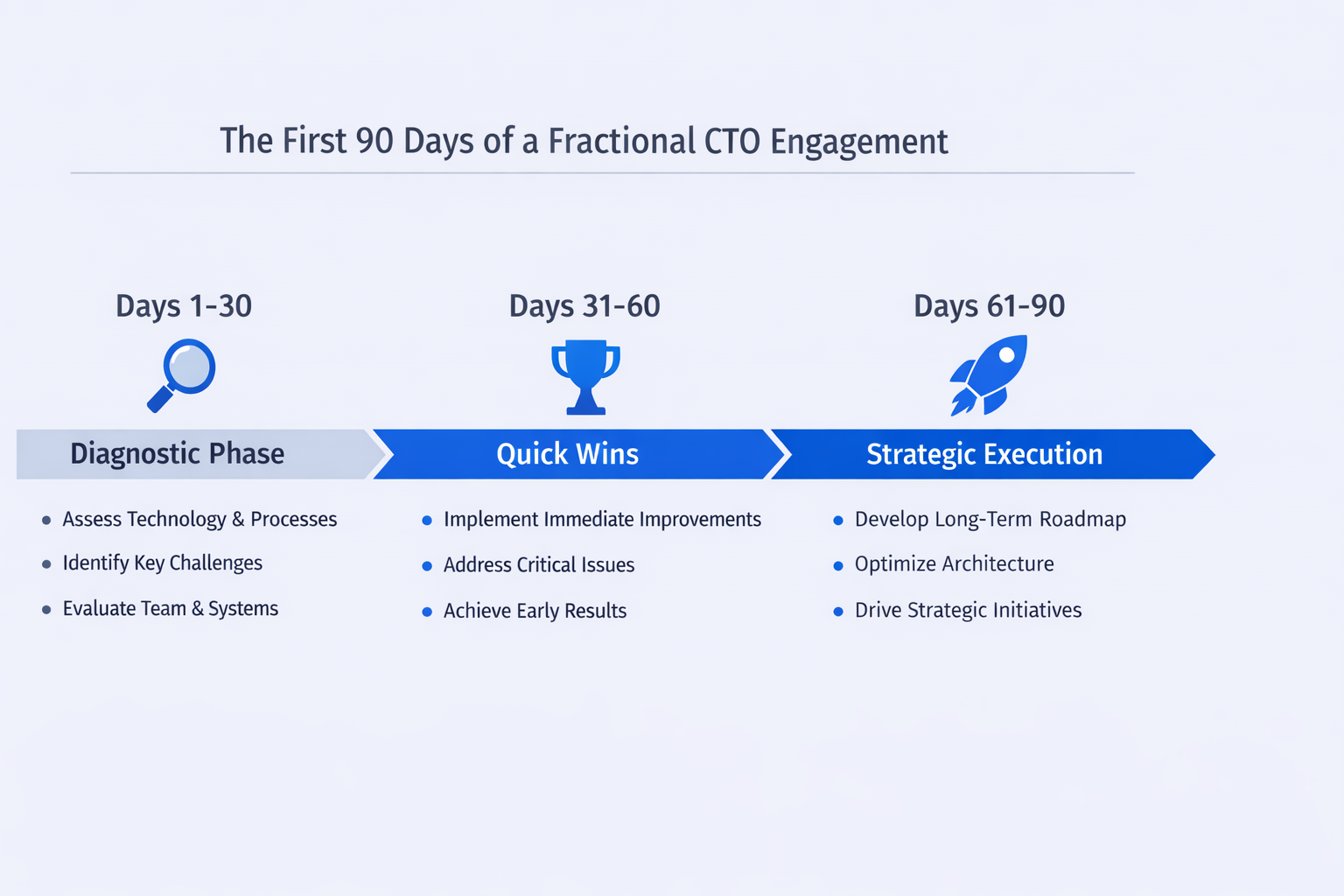
Don’t walk in and start rewriting code. The first 2 weeks should be purely diagnostic.
Stakeholder interviews: Talk to CEO, lead engineer, product manager, sales lead. Their views of “the problem” will differ radically. According to Harvard Business Review research, 72% of new executive failures stem from misalignment in first 30 days.
Create a Technology Operating Charter: Document decision rights. Who decides tech stack? Who decides hiring? Who approves production releases?
The Quick Win Strategy
By Day 30, deliver a tangible win to justify your retainer.
Examples: Automating manual deployment process, negotiating SaaS contract discount, fixing nagging bug that’s annoyed CEO for months.
According to Bain & Company research, executives who deliver quick wins within first 90 days are 2.3x more likely to retain long-term client relationships.
Communication Cadence
Fractional means you’re not there daily. Visibility is currency.
The Weekly Status Email (sent every Friday):
- What we accomplished this week
- What we’re tackling next week
- Key risks or blockers
This simple habit prevents the “What are we paying them for?” question. According to PMI research, projects with weekly status updates have 38% higher success rates than those without.
Common Pitfalls to Avoid
Scope Creep: The Silent Profit Killer
The trap: Client asks you to “just write this one API endpoint.”
The fix: “I can definitely oversee that, but my hourly rate for coding is $500. Better usage of your budget if I assign this to a senior dev and review their PR.”
According to <a href=”https://salesso.com/blog/zoominfo-review/”>ZoomInfo’s</a> 2024 Services Report, 63% of consultants lose profitability to scope creep in first year.
The Availability Paradox
The trap: Client A calls during Client B’s scheduled time.
The fix: Rigid calendaring. “I’m available for synchronous calls Mondays and Wednesdays. I check async messages daily but response time is 24 hours.”
Imposter Syndrome
The trap: Feeling like you don’t know enough about specific new tech (Web3, AI).
The fix: You’re hired for leadership, not syntax. Your job is evaluating technology and hiring the right people—not coding it yourself.
Conclusion
The fractional CTO market is exploding.
As companies seek leaner operations and more agility, “renting” executive expertise is becoming standard operating procedure.
The opportunity is clear: Combine deep technical expertise with rigorous business discipline and systematic client acquisition, and you build a practice offering both financial freedom and intellectual satisfaction.
The key success factors:
Value-based retainers that align incentives and generate predictable revenue Specialized positioning that commands premium rates
Systematic outbound that fills your pipeline with qualified prospects Operational discipline that protects profitability
The companies that need you most aren’t posting jobs. They’re drowning in technical chaos right now, desperate for leadership but unaware the fractional model exists.
Your job is showing up where they already are—LinkedIn—with the right message at the right time.
Build the systems. Do the outreach. Win the clients.
The fractional CTO business model works. The question is whether you’ll <a href=”https://salesso.com/blog/linkedin-sales-navigator-alternatives/”>execute on it</a>.

