
- blog
- Cold Emailing
- How to Write Cold Email That Gets 25%+ Reply Rates
How to Write a Cold Email That Gets Replies: The Complete 2025 Guide
Table of Contents
The world of cold emailing has completely transformed. What worked just two years ago will now land you straight in the spam folder. If you’re still sending generic “Hope this email finds you well” messages to hundreds of prospects, you’re playing an outdated game.
The harsh reality? 71% of decision-makers ignore emails simply because they don’t address their specific needs. Your prospects receive over 120 emails daily, and they guard their attention fiercely. The only emails that break through are those that prove immediate, personal value within the first five seconds.
🎯 Reach Engaged Decision-Makers
Our LinkedIn targeting, campaign design, and scaling system connects you with prospects who respond—not ignore
This isn’t about finding a magic template or secret hack. It’s about mastering a strategic approach that transforms cold outreach from spam into genuine relationship-building. Let’s dive into exactly how to write cold emails that actually get replies.
What Has Changed In The Approach To Cold Emailing?
The shift from “spray and pray” to precision targeting isn’t just a trend—it’s survival. Email platforms like Gmail and Outlook now use AI algorithms that analyze sender reputation, content authenticity, and personalization depth. Send a template-stuffed email, and it’s taking a one-way trip to digital oblivion.
Data privacy regulations have tightened the screws. GDPR and CAN-SPAM Act aren’t suggestions—they’re rules with serious consequences. You must be transparent, provide clear opt-out options, and have legitimate reasons for contact.
The AI paradox has emerged. While AI tools can help research prospects faster than ever, over-reliance produces emails that sound robotic and sterile. Your prospects spot AI-generated content instantly, and it screams “I didn’t put real effort into this.”
Your buyers have evolved. They’re information-saturated and have zero patience for irrelevant pitches. The new mantra isn’t about volume—it’s about hyper-personalization and value-first communication.
Every cold email must answer one critical question within five seconds: “Why should I care?” If it doesn’t, you’ve already lost.
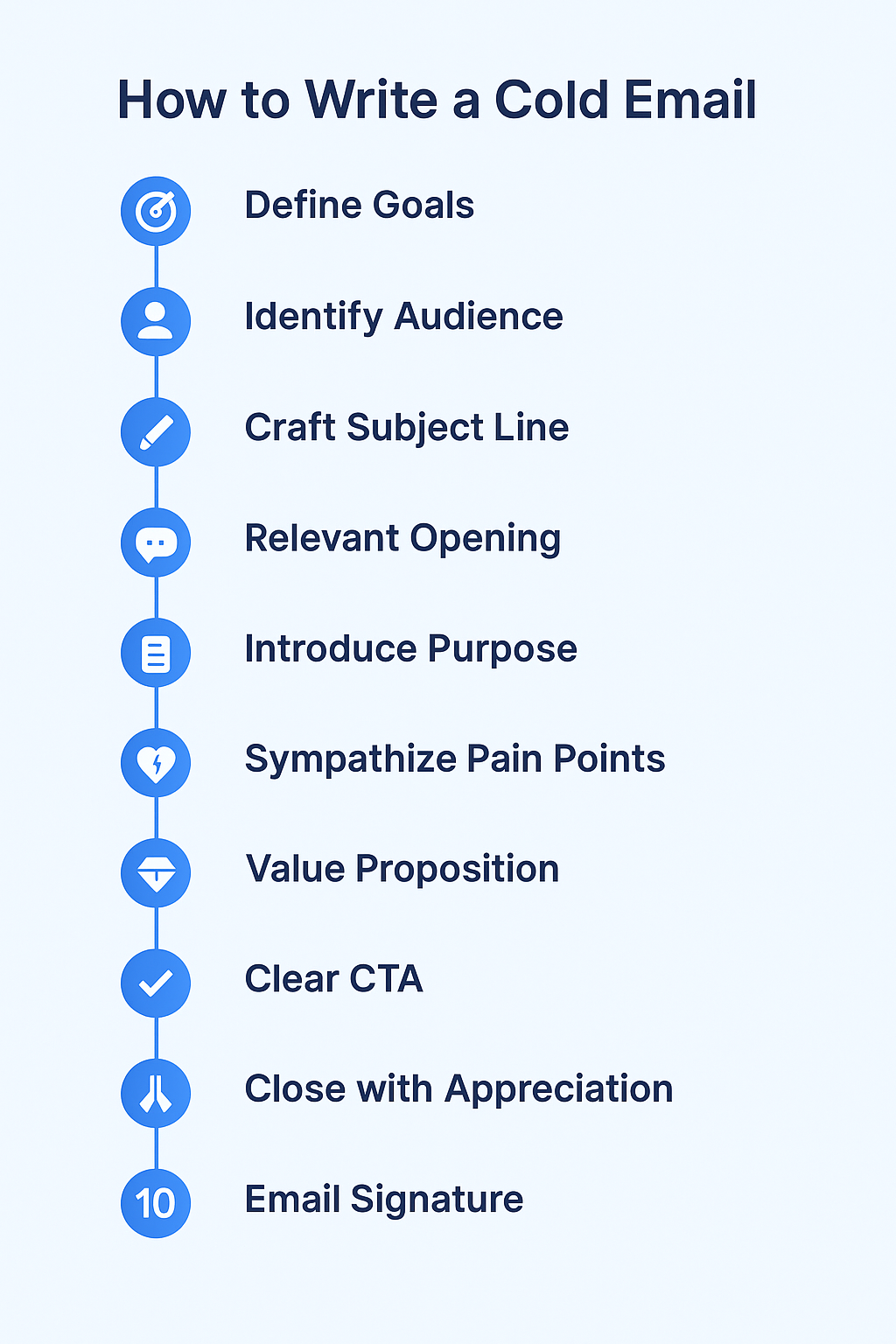
10 Steps for Writing a Cold Email Effectively
Writing effective cold emails isn’t about magic formulas—it’s about following a proven psychological journey from skepticism to engagement. These ten steps guide your prospect through that transformation in roughly 125 words.
Â

Â
Â
Define Your Goals
Before typing a single word, clarity on your objective is non-negotiable. Vague goals create vague, ineffective emails. Your goal must be singular and measurable.
Are you trying to:
- Book a 15-minute discovery call?
- Gauge interest with a simple reply?
- Find the right decision-maker?
- Drive a specific resource download?
Pick one. Trying to achieve multiple goals creates confusion, and confused prospects do nothing. Frame your goal as their win: instead of “book a meeting,” think “learn how to solve X problem.”
Identify Your Target Audience
A perfect email sent to the wrong person is still a failed email. Deep research is the foundation of every successful cold email campaign.
Beyond basic demographics, understand your prospect’s world. What metrics are they judged on? What language do they use? What keeps them awake at night?
Find specific “personalization hooks”:
- LinkedIn Activity: Recent posts, comments, or articles they’ve shared
- Company News: Funding rounds, product launches, or strategic hiring
- Media Appearances: Podcasts, interviews, or industry quotes
- Tech Stack: Tools they use (discoverable through platforms like BuiltWith)
These hooks transform your cold email from generic outreach into relevant conversation starters.
Craft An Irresistible Subject Line
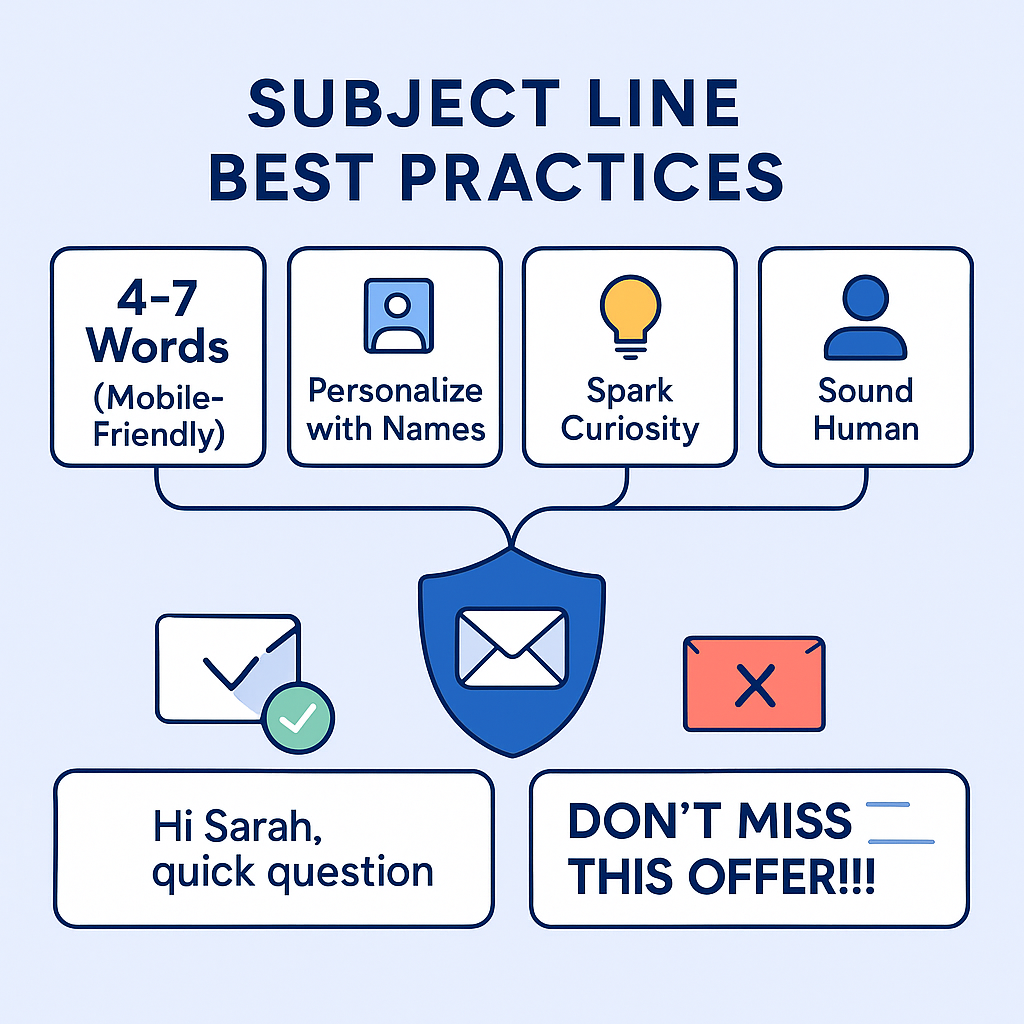
At least 33% of people decide whether to open emails based solely on the subject line. Fail here, and your brilliant content never gets seen.
Â

Â
Rules for high-open subject lines:
- Keep it Mobile-Friendly: 4-7 words (30-50 characters) since 70% of emails open on mobile
- Personalize Strategically: Including names or company names can boost opens by 50%
- Spark Curiosity: Create a “curiosity gap” without giving everything away
- Sound Human: Avoid marketing-speak, ALL CAPS, and excessive punctuation
Examples that work:
- “Quick question, {{FirstName}}”
- “{{CompanyName}} + pipeline idea”
- “Connecting”
- “Question about your recent post”
Start With A Relevant Opening
You have three seconds to prove this email was written specifically for them. Your first sentence is that proof.
Bad: “I hope this email finds you well.” (Instant delete)
Good: “Hi Sarah, I saw your LinkedIn comment about the difficulty of finding accurate contact data for outbound—it’s a problem I hear constantly from sales leaders.”
This opener works because it’s specific, relevant, and shows you’re paying attention to their world. You’re no longer a stranger—you’re someone who understands their challenges.
Introduce Yourself And Your Purpose
Keep your introduction short and sweet—one or two sentences maximum. The focus should pivot back to them as quickly as possible.
Example: “My name is Alex from Salesso. We specialize in helping sales teams overcome that exact data challenge by providing verified, accurate email addresses for their ideal prospects.”
This clearly states who you are, what you do, and directly connects your purpose to the pain point you just mentioned.
Sympathize With Their Pain Points
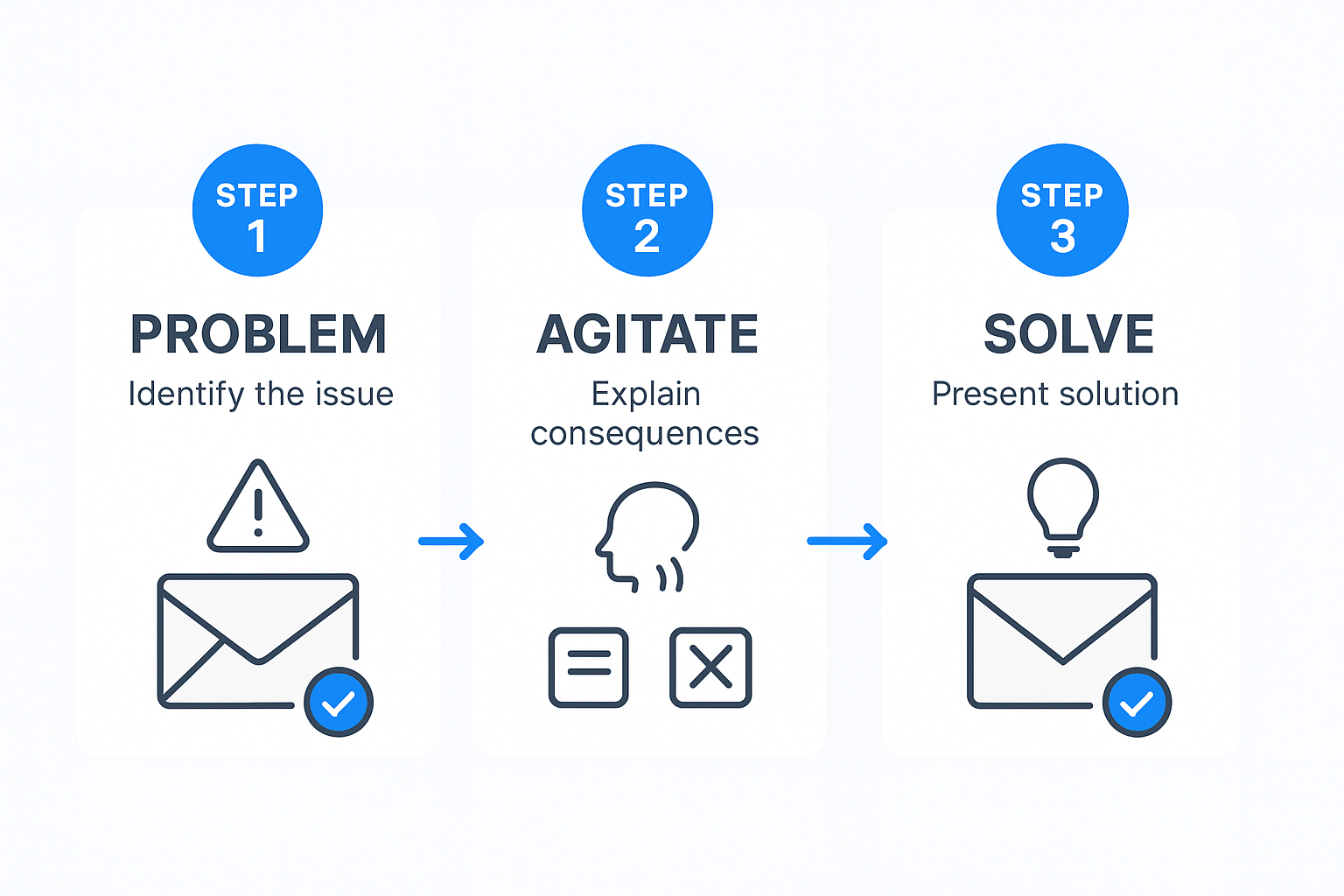
Build trust by demonstrating deep understanding of their problems. Use the Problem-Agitate-Solve (PAS) framework:
Â

Â
- Problem: State it clearly. “Finding accurate contact info is a huge time-sink.”
- Agitate: Explain negative consequences. “Every hour spent searching for emails is an hour not selling, which directly impacts pipeline and can lead to team burnout.”
By agitating the pain, you make the need for a solution feel urgent, setting up your value proposition perfectly.
Add Your Unique Value Proposition
Connect their agitated pain to your solution. Your value proposition must be concise, benefit-oriented, and backed by proof.
Weak: “Our platform helps you find emails faster.”
Strong: “We helped a similar company in your space, [Competitor Name], cut their prospecting time by 35% and increase their meeting booking rate by over 20% in the first quarter.”
Focus on outcomes, not features. They don’t care about your proprietary algorithm—they care about hitting their quota and achieving their goals.
Include A Clear & Direct Call-To-Action
Make it incredibly easy for them to take the next step. One email, one CTA. Don’t ask them to book a meeting and visit your website.
Use low-friction asks that start conversations rather than demanding commitments:
High-Friction (Bad): “Do you have time for a 30-minute demo next Tuesday at 2 PM?”
Low-Friction (Good): “Would you be open to seeing the 3-step process we used to get those results for [Competitor Name]?”
Even better: “Is improving your team’s outbound efficiency a priority for you right now?”
This is easy to answer from their phone and opens the door for deeper conversation if the answer is “yes.”
Close Your Email With Appreciation
End on a professional, positive note. Simple works best. Closings that express gratitude like “Thanks in advance” can significantly boost response rates.
Examples: “Best,” “All the best,” “Thanks,” or “Looking forward to your thoughts.”
Don’t Forget Your Email Signature
Your signature is your digital business card, lending credibility and proving you’re a legitimate professional, not a spammer.
Essential elements:
- Your Full Name
- Job Title
- Company Name & Website (hyperlinked)
- Phone Number
- LinkedIn Profile URL
Pro Tip: Avoid large images or excessive links—they trigger spam filters and hurt deliverability.
Four Mistakes To Avoid
These four mistakes kill more cold emails than any other factors. They all stem from one root cause: lack of empathy for the person receiving your message.

💡 Skip Email Challenges Entirely
LinkedIn outbound eliminates deliverability and response rate issues with proven targeting, messaging, and scaling methods
Making it All About You (The Self-Centered Pitch)
The Symptom: Your email is packed with “I,” “we,” and “our company” sentences, reading like a company brochure.
The Cure: Make the prospect the hero of your story. Your email should focus on them, their challenges, and their goals. Before hitting send, count your “we’s” versus “you’s”—if you have more “we’s,” rewrite it.
Writing a Novel (Long, Dense Paragraphs)
The Symptom: Your email exceeds 150 words and looks like a solid text block.
The Cure: Be ruthless with editing. The ideal length is 50-125 words. Use short sentences (under 15 words) and even shorter paragraphs (2-3 lines max). Treat whitespace as your friend—it makes emails scannable and less intimidating.
Being Too Aggressive or “Salesy”
The Symptom: Your email is full of buzzwords like “synergy” and “revolutionize,” with demanding CTAs like “Let’s schedule a 30-minute demo tomorrow.”
The Cure: Write like a human being. Read your email aloud—does it sound like natural conversation? The goal is to be helpful and start dialogue, not close deals in the first email.
Neglecting to Follow Up (or Following Up Poorly)
The Symptom: You give up after one email, or your follow-ups are value-less “just checking in” messages.
The Cure: Up to 80% of sales require at least five follow-ups. Every follow-up must provide new value—share relevant case studies, helpful blog posts, different insights, or reframe your value proposition from new angles. Be persistent, but be valuable.
🚀 Get 3X Higher Response Rates
Our complete LinkedIn outbound engine delivers better engagement through strategic targeting, campaign design, and automated scaling
7-day Free Trial |No Credit Card Needed.
How To Send Your First Cold Email Campaign With Salesso
You’ve learned the strategy—now let’s put it into action with the right tools. Here’s how to launch your first professional cold email campaign using Salesso.
Create A New Campaign
Log into your Salesso dashboard and click “Create New Campaign” to get started. The interface is designed for quick setup while maintaining professional standards.
Add Your Campaign Name
Use a clear, descriptive naming convention that helps track results: “[Target Role] – [Offer] – [Date]”
Example: “VP of Sales – Q3 Pipeline Offer – Oct 2025”
Set The Sending Limit
Protect your sender reputation by starting slow and gradually increasing volume. Begin with 30-50 emails per day from each account. This mimics natural human behavior and builds trust with email providers, ensuring inbox delivery.
Write The Email
Apply the 10-step framework using Salesso’s editor. Use personalization tokens like {{FirstName}}, {{CompanyName}}, and custom fields for your research hooks like {{PersonalizationHook}}. Write one master template that feels unique for every prospect.
Schedule The Sending Time
Timing dramatically impacts open and reply rates. Tuesday, Wednesday, and Thursday perform best, with peak engagement between 8-10 AM and 1-3 PM in your prospect’s local time zone.
Salesso automatically schedules optimal send times based on recipient location.
Add Follow-Ups
Build a multi-step sequence of 3-5 follow-up emails that automatically send if prospects don’t reply. Set delays between steps (e.g., wait 3 days before the first follow-up) and customize each message to provide new value. This can increase reply rates by over 40%.
Add Your Prospect List
Upload your verified B2B email list as a CSV file. Salesso automatically maps columns to personalization snippets, ensuring perfectly tailored emails.
Send A Test Campaign
Use Salesso’s “Send Test Email” feature to review your message for typos, broken links, or formatting issues before launching to hundreds of prospects.
Click Start
Once everything looks perfect, click “Start Campaign.” Salesso handles the rest, sending personalized emails and follow-ups according to your schedule while you focus on talking to interested prospects.
Top Cold Emailing Templates & Examples
Here are five battle-tested templates for common scenarios. For each one, we’ll break down why it works so you can adapt the principles.
Cold Email Template For Networking
When to use: Connecting with industry peers, potential mentors, or seeking advice for relationship-building.
Subject: Connecting with a fellow [University Name] alum
Hi {{FirstName}},
My name is [Name], and I’m a [Title] at [Company]. I came across your profile on LinkedIn and was incredibly impressed by your work in [Industry], especially your recent project on [Specific Project].
As a fellow [University Name] graduate, I’m always inspired to see where alumni have built their careers. I’m currently focused on growing my expertise in [Area] and would be grateful for the chance to ask you a couple of questions about your journey.
Would you be open to a brief 15-minute chat sometime in the next couple of weeks to share some advice?
Best, [Your Name]
Why This Works:
- Establishes Common Ground: Creates immediate connection through shared alma mater
- Genuine Compliment: Shows research through specific project mention
- Low-Friction Ask: Requests “advice,” which is flattering and low-commitment
Cold Email Example For Partnership
When to use: Proposing collaborations, co-marketing opportunities, or strategic alliances.
Subject: {{Your Company}} + {{CompanyName}} | Partnership Idea
Hi {{FirstName}},
I’ve been following {{CompanyName}} for a while, and I’m a huge fan of how you’re solving [Problem they solve]. Your recent launch of [Specific Product/Feature] was particularly brilliant.
My name is [Name], and I’m the [Title] at {{Your Company}}. We help [Target Audience] achieve [Goal] by providing [Solution].
I noticed there’s a strong synergy between our audiences. Many of our customers are looking for a solution for [Problem they solve], and I imagine your customers could benefit from [Your Solution].
I have a few ideas for how a partnership could provide significant value to both of our customer bases. Are you the right person to discuss this with? If not, could you point me in the right direction?
Thanks, [Your Name]
Why This Works:
- Focus on Mutual Benefit: Frames as “win-win” from the beginning
- Demonstrates Research: Proves understanding of their business and genuine synergy opportunity
- Respectful CTA: Simple request for referral, ensuring you reach the right decision-maker
Cold Email Template For Internship Inquiry
When to use: Students or recent graduates seeking unlisted internship opportunities.
Subject: Internship Inquiry: Passion for [Industry] & [Company Name]
Dear {{Hiring Manager Name}},
My name is [Name], and I am a [Year] student at [University] studying [Major]. I have been following {{CompanyName}}’s innovative work in [Industry], and your commitment to [Company Value or Mission] deeply resonates with my own career aspirations.
I’ve been actively developing my skills in [Relevant Skills] through projects like [Specific, relevant project], where I was able to [Achieve a specific, quantifiable result]. I am confident I could bring this same passion and proactive approach to support your team.
I know how busy you are, but I was hoping to inquire about any potential internship opportunities for the upcoming semester. I’ve attached my resume for your review and would welcome the chance to discuss how I could contribute to {{CompanyName}}.
Thank you for your time and consideration.
Sincerely, [Your Name]
Why This Works:
- Proactive and Passionate: Shows initiative and genuine interest in company mission
- Value-Oriented: Focuses on skills and value they can contribute, not just asking for opportunity
- Professional and Respectful: Polite tone with clear but respectful CTA
Cold Email Example For Potential Client
When to use: B2B sales prospecting (your bread-and-butter template).
Subject: Idea for {{CompanyName}}’s sales pipeline
Hi {{FirstName}},
I saw your recent LinkedIn post about the challenge of scaling your sales team while maintaining lead quality. It’s a common struggle I hear from sales leaders in the SaaS space.
My name is [Name], and I work with sales leaders to solve this exact problem.
Typically, when teams scale quickly, sales reps end up spending more time on manual prospecting than actual selling, which can crush morale and pipeline growth.
We recently helped [Similar Company] cut their prospecting time by 40% and increase qualified meetings booked by 23% in one quarter.
Is improving your outbound team’s efficiency a priority for you right now?
Best, [Your Name]
Why This Works:
- Hyper-Personalized Opener: Specific, relevant hook proving email is just for them
- Problem-Agitate-Solve: Perfect PAS formula execution
- Quantified Social Proof: Specific metrics and named company make value tangible
- Low-Friction CTA: Simple yes/no question gauging interest without pressure
Cold Email Template For Follow-Up
When to use: 3-4 business days after initial email with no response.
Subject: Re: Idea for {{CompanyName}}’s sales pipeline
Hi {{FirstName}},
Just wanted to quickly follow up on my previous email. I know how busy things can get.
When we helped [Company] boost their meeting rate by 23%, the key was providing their team with hyper-accurate contact data, which eliminated wasted dials and bounced emails.
Here’s a short case study that breaks down exactly how we did it: [Link]
Would you be open to learning more?
Best, [Your Name]
Why This Works:
- Provides New Value: Adds case study link instead of “just checking in”
- Contextual and Concise: Briefly reminds of original context without requiring re-read
- Persistent but Polite: Respectful of time while gently nudging conversation forward
Final Words
Mastering cold email in 2025 isn’t about finding secret hacks—it’s about a fundamental mindset shift. Trade volume for value, automation for authenticity, and pitching for problem-solving.
The modern cold email is built on empathy. It requires stepping out of your shoes as a seller and into your buyer’s world. It demands research, understanding their challenges, and respecting their time.
The principles are simple, but execution requires discipline:
- Be Personal: Prove you know who you’re talking to
- Be Relevant: Talk about their problems, not your product
- Be Concise: Get to the point quickly and clearly
- Be Valuable: Give before you ask
Follow these steps and principles, and you won’t just send another inbox-clogging email. You’ll start meaningful conversations, build relationships, and create opportunities that fill your pipeline and drive success.
FAQs
How Long Should A Cold Email Be?
What's an Example of Writing a Cold Email?
How To Stand Out In Cold Emails?
Is Cold Emailing Illegal?
Does Cold Emailing Really Work?
LinkedIn Outbound Gets Better Results
Skip spam filters and get higher reply rates with our complete targeting, campaign design, and scaling methodology
Segmentation That Actually Converts
LinkedIn outbound targets precise demographics with strategic campaign design and scaling methods