Sign Off with Your Name and Contact Information
End professionally to reinforce credibility.
Use a professional closing and include a clean email signature with:
- Your full name
- Job title and company name
- LinkedIn profile URL
Proofread Your Email
Before hitting send, read your email out loud. This helps catch typos, grammatical errors, and awkward phrasing that spell-check might miss.
Errors make you look unprofessional and careless, eroding the trust you’re trying to build.
Follow-up Email Templates & Examples
Here are 16 battle-tested followup email templates for different situations. Use them as starting points and personalize for your recipients.
The Gentle Nudge (First Follow-Up)
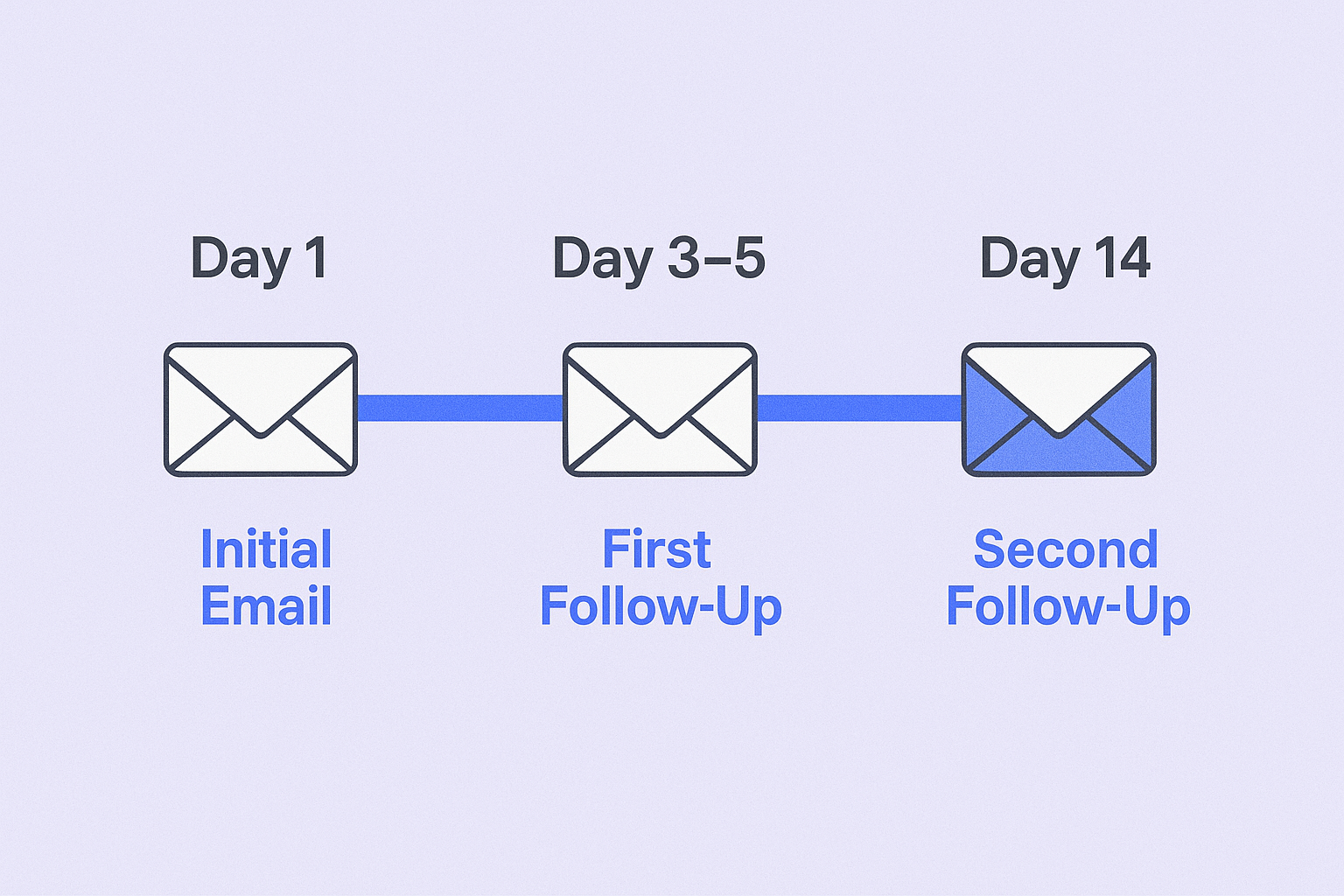
When to use: 2-3 days after your initial email with no response.
Subject: Re: [Original Subject]
Hi [First Name],
I’m just circling back on the email I sent last week about [briefly state your value prop].
I know how busy things can get. Is [solving pain point] something on your radar right now?
Best,
[Your Name]
Why it works: It’s polite, professional, and low-pressure. The simple yes/no question makes it easy to respond.
The Value-Add Follow-Up
When to use: 4-5 days after your first follow-up with still no reply.
Subject: Re: [Original Subject]
Hi [First Name],
Hope you’re having a productive week.
I was thinking more about your team at [Company Name] and wanted to share a case study on how we helped [similar company] achieve [specific result].
You can see the full story here: [link]
Let me know if a brief chat to discuss how you could see similar results makes sense.
All the best,
[Your Name]
Why it works: It shifts focus from “I want something” to “I have something for you.” It provides valuable social proof.
The “Right Person?” Follow-Up
When to use: When you’re unsure if you’re contacting the correct decision-maker.
Subject: Re: [Original Subject]
Hi [First Name],
I sent an email a few days ago about [your service area] and realized I might be knocking on the wrong door.
My company provides solutions for [explain your offer in one line]. Are you the right person to speak with about this? If not, could you kindly point me in the right direction?
Thanks for your help,
[Your Name]
Why it works: It’s humble and makes the ask simple. People often help redirect you politely, turning a cold lead into a warm referral.
After a Cold Call/Voicemail
When to use: Immediately after leaving a voicemail.
Subject: Sorry I missed you
Hi [First Name],
I just left you a voicemail but wanted to drop a line by email in case this is more convenient.
I was reaching out because [reiterate the purpose of your call in one sentence]. I believe we can help your team with [benefit], and I’d love the chance to connect when you’re available.
If you prefer, just reply to this email with a good time and I’ll call you then.
Best,
[Your Name]
Why it works: It reinforces your message across channels and provides an easier way to respond than calling back.
After a Networking Event
When to use: Within 24 hours of meeting someone at a conference or event.
Subject: Great connecting at [Event Name]!
Hi [First Name],
It was a pleasure meeting you at [Event Name] yesterday. I really enjoyed our conversation about [specific topic you discussed].
As promised, here is the [resource you mentioned] on [topic]: [link]
I’d love to continue our conversation. Are you available for a quick 15-minute call next week?
Regards,
[Your Name]
Why it works: It’s timely, personal, and fulfills a promise, building immediate trust and credibility.
After LinkedIn Connection
When to use: After someone accepts your connection request or engages with your content.
Subject: Thanks for connecting on LinkedIn
Hi [First Name],
Thanks for connecting with me on LinkedIn. I saw your post about [topic] and found your perspective on [specific point] really interesting.
Many companies in [their industry] are struggling with [pain point]. We help by [one-line value prop].
If you’re open to it, I’d be happy to share a few ideas on how you could tackle this.
Best,
[Your Name]
Why it works: It transitions from social to business while feeling warm and contextual, not like a sudden cold pitch.
The Quick Question Follow-Up
When to use: When you want to re-engage with a very low-friction ask.
Subject: Quick question about [Company Name]
Hi [First Name],
Following up on my previous email. I have one quick question:
What’s your team’s biggest challenge right now when it comes to [your area of expertise]?
Any insight you can share would be helpful.
Thanks,
[Your Name]
Why it works: It’s short, direct, and focuses on them. The open-ended question invites a response and provides valuable information.
The “Break-Up” Email (Final Attempt)
When to use: After 3-4 follow-ups with no response.
Subject: Can I close your file?
Hi [First Name],
I’ve tried to get in touch a few times without success. Since I haven’t heard back, I’ll assume that [solving pain point] isn’t a priority for you right now.
I won’t contact you again, but please feel free to keep my information on file if things change in the future.
All the best,
[Your Name]
Why it works: This leverages loss aversion psychology. The idea of being “removed” can trigger responses from interested but busy prospects.
After a Demo or Discovery Call
When to use: Within a few hours of a successful demo or call.
Subject: Great chat today – next steps
Hi [First Name],
Thanks again for your time today. I really enjoyed learning about your goals at [Company Name] and your challenges with [pain point].
As discussed, I’ve attached the [resource] that details how we can help you [achieve specific goal].
Based on our conversation, the next logical step is to [specific next step]. Does [date/time] work for a 30-minute call?
Best,
[Your Name]
Why it works: It’s prompt, professional, and drives momentum by recapping value and defining clear next steps.
After Sending a Proposal
When to use: 3-5 days after sending a proposal and waiting for feedback.
Subject: Any questions on the proposal?
Hi [First Name],
Hope you’re having a good week.
I wanted to follow up on the proposal I sent over on [date]. Have you had a chance to review it with your team?
I’m here to answer any questions you might have or adjust anything to better fit your needs. Your feedback is really valuable at this stage.
Let me know what you think when you have a moment.
Regards,
[Your Name]
Why it works: It’s a polite check-in that opens the door for questions and positions you as a helpful consultant.
When a Contact Goes Dark
When to use: Your main contact who was previously engaged has stopped responding.
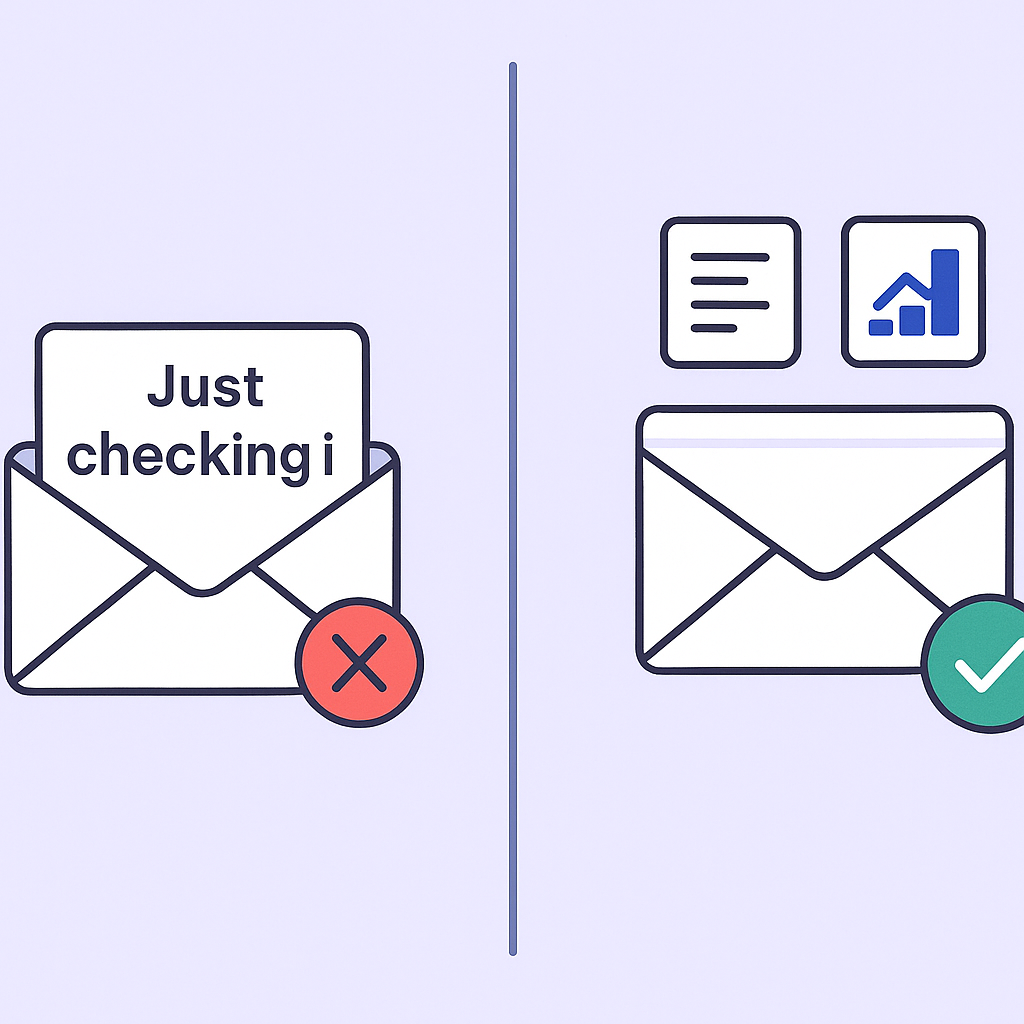
Subject: Just checking in
Hi [First Name],
Just wanted to check in, as I haven’t heard from you in a little while.
I know priorities can shift quickly. Is the [project name] initiative still on your roadmap for this quarter?
Happy to help in any way I can if things have stalled.
Best,
[Your Name]
Why it works: It’s empathetic and low-pressure. It acknowledges that things change without making them feel defensive.
Checking on a Free Trial
When to use: Midway through a prospect’s free trial period.
Subject: How’s the trial going?
Hi [First Name],
I noticed you’re about halfway through your trial of [Product Name]. How’s it going so far?
Many of our most successful customers found huge value in the [specific feature] at this stage. Have you had a chance to try it out?
I’m happy to jump on a quick 10-minute call to make sure you’re getting the most out of the trial.
Cheers,
[Your Name]
Why it works: It’s proactive and helpful. By pointing them toward a high-value feature, you increase conversion chances.
To the Decision-Maker
When to use: When your contact needs buy-in from their boss or stakeholder.
Subject: [Contact’s Name] and I discussed [Project]
Hi [Decision-maker’s Name],
I recently had a great conversation with [Contact’s Name] about the challenges your team is facing with [pain point].
We discussed how [your solution] could help achieve [business outcome]. [Contact’s Name] mentioned you would be the key decision-maker for this initiative.
I’ve attached a brief, one-page summary tailored for you. Would you be open to a brief call next week to discuss this further?
Best regards,
[Your Name]
Why it works: It leverages internal credibility and frames the conversation around high-level business outcomes.
Re-engaging a Lost Deal
When to use: 3-6 months after a deal was lost or went cold.
Subject: Circling back
Hi [First Name],
Hope all is well.
The last time we spoke, you mentioned that [reason deal was lost]. I wanted to circle back to see if anything has changed on your end.
We’ve recently launched [new feature] that I think could be a game-changer for you. Is this worth a quick chat next week?
Best,
[Your Name]
Why it works: It’s low-pressure and provides a fresh reason to re-evaluate your solution.
Following Up on a Specific Request
When to use: When someone asked for specific information and you’re delivering it.
Subject: Good news! I have the info you requested
Hi [First Name],
Thank you for speaking with me on [date].
As promised, I checked with our [team] regarding your question about [their request]. I’m happy to confirm that we can [provide positive answer].
I’ve attached more detailed information for you. Please let me know how you’d like to proceed.
Regards,
[Your Name]
Why it works: It demonstrates reliability and follow-through, building trust in the process.
The Meeting Recap Email
When to use: After any significant meeting or call.
Subject: Recap of Our Meeting on [Date]
Hi [First Name],
It was great meeting with you today and discussing [meeting topic].
To ensure we’re on the same page, here’s a quick summary of what we discussed and agreed-upon next steps:
**Main Points:**
– [Key Point 1]
– [Key Point 2]
– [Key Point 3]
**Agreed Actions:**
– [Action 1] – Owner: [Name] – Due: [Date]
– [Action 2] – Owner: [Name] – Due: [Date]
Please let me know if I missed anything important.
All the best,
[Your Name]
Why it works: It provides clear documentation, prevents misunderstandings, and shows you’re organized and professional.
Why It Is Important to Send a Good Follow-Up Email
In professional communication, persistence is key, but it must be polite and value-driven. A well-crafted followup email isn’t just an administrative task—it’s a core skill with measurable impact.
It Dramatically Boosts Reply Rates
The data is clear: your first email is often just the opening act. Sending even one follow-up can increase your reply rate by 22%. The first follow-up has a 40% higher reply rate than other messages in a sequence.
It Helps You Stand Out
An incredible 70% of email chains stop after the first attempt. By simply sending a second, thoughtful email, you’re already in the top 30% of professionals. This signals diligence and genuine belief in providing value.
It Aligns with How People Actually Work
Recipients are busy, not necessarily uninterested. Their inboxes overflow with priorities, and your initial message can easily get buried. A follow-up serves as a professional nudge, bringing your message back to the top at a more convenient time.
66% of people prefer to be contacted via email for follow-ups. The primary function isn’t just to “remind” but to reduce cognitive load for re-engagement.